Développement de l'enfant : Des premiers pas hésitants aux grands bonds – Zoom sur les pieds et les jambes
La petite enfance est marquée par un développement physique et cognitif rapide. Nous attendons chaque étape avec impatience, depuis ces premiers pas jusqu'aux bonds énergiques qui suivent.
Bien que nous célébrions l'expérience dans sa globalité, il est crucial de porter une attention particulière à la base de ce progrès : les pieds et les jambes.
Le fondement de la mobilité : Développement des pieds et des jambes
Les pieds et les jambes des jeunes enfants sont en croissance constante, posant les jalons d'une vie entière de mouvement. Comprendre ce processus peut vous aider à détecter et prévenir d'éventuels problèmes, tout en favorisant un développement sain.
Étapes clés du développement
12-18 mois : Les enfants commencent à se hisser et à faire leurs premiers pas indépendants. Leur démarche peut être instable, avec un écartement large pour l'équilibre.
18-24 mois : Ils perfectionnent la marche, commencent à courir — bien que de manière maladroite — et peuvent tenter de monter les escaliers avec de l'aide. La voûte plantaire commence à se former, même si les pieds peuvent encore paraître plats.
2-3 ans : La course devient plus fluide, les sauts apparaissent et ils peuvent monter les escaliers seuls. Leurs pieds et leurs jambes sont plus forts, et leur démarche est plus stable.
3-4 ans : Ils peuvent sautiller, bondir et effectuer des mouvements complexes. Les muscles des pieds et des jambes sont bien développés, favorisant une agilité accrue.
Comprendre le développement du pied et de la jambe
Développement de la voûte plantaire : La plupart des enfants ont les pieds plats au départ, car la voûte se développe progressivement. Vers 3 ou 4 ans, elle devient plus prononcée.
Force musculaire : Les muscles des jambes se renforcent pendant la petite enfance, permettant des mouvements plus complexes.
Croissance osseuse : Les os des jeunes enfants — principalement composés de cartilage — se transforment progressivement en os, ce qui les rend sensibles aux problèmes de croissance.
Évolution de la marche : Le dandinement instable se transforme en une foulée plus coordonnée et efficace.
Préoccupations communes et problèmes potentiels
Marche en dedans / en dehors : Bien qu'elles se résorbent souvent d'elles-mêmes, les formes persistantes ou sévères nécessitent une évaluation.
Marche sur la pointe des pieds : Si elle persiste, elle peut indiquer des problèmes sous-jacents et doit être prise en charge.
Pieds plats : Fréquents, mais s'ils s'accompagnent de douleurs ou d'inconfort, une visite chez le pédiatre s'impose.
Pronation / Supination : Un roulement excessif du pied vers l'intérieur ou l'extérieur peut affecter la démarche et causer de l'inconfort.
Inégalité de longueur de jambe : Une différence peut affecter la posture et la démarche de votre enfant.
Retards de développement : Un retard dans l'acquisition des étapes motrices peut signaler un trouble de la croissance.
Favoriser un développement sain
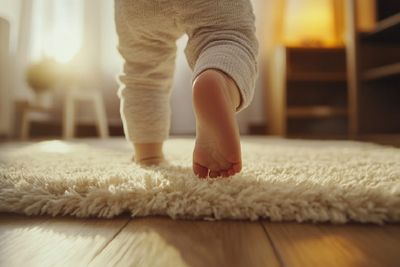
Jeux pieds nus : Encouragez votre enfant à explorer différentes textures et surfaces pieds nus. Cela favorise le développement sensoriel et renforce les muscles du pied.
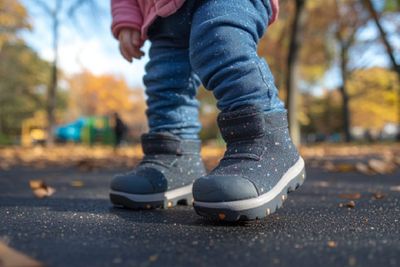
Chaussage adapté : Choisissez des chaussures à la bonne taille, offrant un soutien de la voûte plantaire et permettant le mouvement naturel du pied.
Encourager le mouvement : Multipliez les occasions d'activités physiques variées (courir, sauter, grimper).
Suivi régulier : Planifiez des bilans de santé réguliers avec un pédiatre pour surveiller le développement.
Réagir rapidement : Si vous remarquez une démarche inhabituelle, consultez un professionnel de santé.
Alimentation nutritive : Une alimentation riche en calcium et en vitamine D est essentielle pour la santé osseuse.
Limiter le temps d'écran : Privilégiez le jeu actif à la sédentarité pour favoriser le développement physique.
Quand consulter un professionnel
Douleurs ou inconfort persistants dans les pieds ou les jambes.
Changements notables dans la démarche ou la posture.
Retards dans l'acquisition des étapes motrices.
Déformations visibles ou positions inhabituelles du pied.
Inquiétudes générales concernant le développement de votre enfant.
En comprenant le développement des pieds et des jambes de votre enfant, vous pourrez lui apporter le soutien et les conseils nécessaires pour qu'il avance d'un pas sûr vers un avenir sain et actif.