Can Out-Toeing Delay Walking in Children - First...

In this article

Can Out-Toeing Delay Walking as Children Grow? What Experts Say

Mild out-toeing does not delay walking in most children and is unrelated to walking milestones. However, severe out-toeing (over 35 degrees) or out-toeing combined with other conditions may interfere with balance, potentially affecting walking progress.

a woman standing in front of a curtain
By Anjana Iyer
a woman standing in front of a brick wall
Edited by Nerissa K. Naidoo

Published February 6, 2026

A toddler with out-toeing running.

Is your child's duck-footed walk slowing down their progress? It's natural to worry when your little one's feet turn outward, and their gait looks wider or different from what you expected.

Now, in most cases, out-toeing in children won't delay walking at all. It's just one of many normal variations you'll see as your child learns to move.

This guide will help you understand when out-toeing affects walking development, what warning signs to watch for, and how to support your child's healthy progress.

» Explore our range of the best pre-walker shoes to support your baby's first steps

All About Out-Toeing and Walking Delays in Children

Out-toeing, or duck-footed walking, happens when your child's feet point outward instead of straight ahead. In most children, mild out-toeing does not delay walking milestones [1].

Your child's gross motor development and walking timeline depend more on overall muscle strength, balance, and coordination than on foot position. Isolated, mild out-toeing without other conditions won't affect when your child starts walking independently.

However, severe out-toeing can interfere with walking development. This happens when the shin bone rotates outward more than 35 degrees or the thigh bone rotates outward more than 65 degrees [2].

Note: These severe cases are rare and usually only occur with underlying bone, cartilage, or genetic conditions.

When Out-Toeing Affects Walking Development in Children

Severe out-toeing can change how your child walks in several ways. The outward foot position affects knee bending, leg swing, and pelvis rotation during each step [3]. This makes the base of support narrower, making balance harder.

Watch for these warning signs that suggest out-toeing may affect your child's walking:

  • Severe out-toeing measuring more than 35-65 degrees.
  • Sudden out-toeing that appeared within a week.
  • Out-toeing accompanied by toe walking and pain or limping.
  • Severe out-toeing on only one side [4].

Your child may walk unsteadily, take shorter steps, or fall frequently. These challenges can make them avoid walking on uneven surfaces or prefer crawling over walking. If you notice these patterns, it's worth getting your child evaluated.

Other conditions can also increase walking delays alongside out-toeing, including low or high muscle tone, cerebral palsy, Down syndrome, severe flat feet, or obesity [5].

Supporting Healthy Walking Development in Children With Out-Toeing

The best way to support your child is through movement and proper footwear, not correction attempts:

Encourage lots of physical activity. Let your child play independently on playgrounds and walk on varied surfaces like sand or grass. These experiences help them adapt and build the strength needed for walking [6].

Choose supportive footwear with a firm heel counter, flexible sole, or shoes with a wide toe box, and secure closures. This protects their feet while allowing natural movement.

Avoid aggressive stretching, braces, or special corrective shoes. These don't change bone rotation and can actually harm normal development [7]. Let your child develop naturally through play and activity.

If out-toeing is sudden, painful, or accompanied by other concerns, consult a physiotherapist or pediatrician for guidance.

» Support your little one's feet with orthopedic shoes

Out-Toeing and Your Child's Walking Progress

Most children with out-toeing walk on time and outgrow the pattern by age 4-6 years. The duck-footed walk you're seeing is usually just your child's body figuring out balance and coordination.

Mild out-toeing won't slow your child down. But if you notice severe rotation, pain, sudden changes, or frequent falls, seek professional evaluation.

With the right support, proper orthopaedic footwear, plenty of movement opportunities, and patience, your child will develop the strength and coordination they need for confident walking.

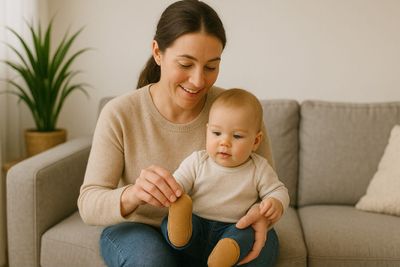
A close up of a baby wearing hard-soled shoes.

Put an End to Out-Toeing

Explore our guide to the best first walker shoes for healthy foot alignment.

References

1. Raising Children Network, "Gait disorders: pigeon toe, out-toeing, toe-walking." https://raisingchildren.net.au/guides/a-z-health-reference/gait-disorders-pigeon-toe-out-toing-toewalking

2. Pediatric Orthopedics, "In-toeing, out-toeing: what parents need to know about toddler gait." https://pediatricorthopedics.com/in-toeing-out-toeing-what-parents-need-to-know-about-toddler-gait/

3. Pediatric Orthopedics, "In-toeing, out-toeing," 2024. https://pediatricorthopedics.com/in-toeing-out-toeing-what-parents-need-to-know-about-toddler-gait/

4. Pediatric Orthopedics, "In-toeing, out-toeing," 2024. https://pediatricorthopedics.com/in-toeing-out-toeing-what-parents-need-to-know-about-toddler-gait/

5. POSNA, "Torsional Problems." https://posna.org/physician-education/study-guide/torsional-problems

6. East Lancashire Hospitals NHS Trust, "Out-toeing referral guide." https://elht.nhs.uk/application/files/8417/5862/0463/out_toeing_referral_guide_.pdf

7. East London NHS Foundation Trust, "Out-toeing leaflet," Dec. 2023. https://www.elft.nhs.uk/sites/default/files/2024-09/ELFT%20out-toeing%20leaflet%20dec%202023.pdf

Disclaimer: First Walkers' information is intended for educational and informational purposes related to toddler footwear and feet. We encourage you to consider individual circumstances and consult qualified orthopedists about specific conditions.

FAQs

Is out-toeing bad for my child?

In most cases, no. Mild out-toeing is a normal variation during early walking and doesn't cause harm. Severe out-toeing or out-toeing with pain may require evaluation.

What is considered severe out-toeing in children?

Severe out-toeing is shin bone rotation over 35 degrees or thigh bone rotation over 65 degrees. This is rare and usually only occurs with underlying bone or genetic conditions.

Can duck-footed walking correct itself?

Yes, most children naturally outgrow out-toeing by age 4-6 years as their bones rotate into proper alignment and their muscles strengthen.

Should I buy special shoes to correct my child's out-toeing?

No. Special corrective shoes and braces do not change bone rotation and can harm normal development. Choose supportive, flexible footwear that allows natural movement instead.

When should I worry about my child's duck-footed walking?

Seek evaluation if out-toeing is sudden, severe, painful, only on one side, or accompanied by frequent falls, muscle stiffness, or developmental delays.

Can out-toeing cause knee problems later in life?

In a small number of cases with severe or persistent out-toeing, knee pain or instability may develop later, potentially affecting running or jumping.

Does out-toeing mean my child has flat feet?

Not necessarily. Flat feet can coexist with out-toeing, but they're separate conditions. Both are common in early walkers and often resolve naturally.

What activities help children with out-toeing walk better?

Playground activities, walking on uneven surfaces like sand or grass, swings, slides, climbing, and squatting all help strengthen the muscles needed for walking.

Will physical therapy help my child's out-toeing?

Physical therapy can help if out-toeing is severe, painful, or accompanied by muscle tone differences or developmental delays. For mild cases, normal play and activity are usually enough.

How does severe out-toeing interfere with walking mechanics?

Severe out-toeing changes knee bending, leg swing, and pelvis rotation. It narrows the base of support, making balance harder and causing unsteady, slow walking with frequent falls.

Why do parents worry so much about out-toeing delaying walking?

Many parents compare their child's duck-footed walk to adult gait and assume something's wrong. New parents often lack exposure to normal pediatric development patterns, leading to unnecessary worry.

Can obesity make out-toeing worse in children?

Yes, obesity can coexist with out-toeing and may contribute to delayed walking milestones by placing extra stress on developing joints and muscles.

What long-term risks does persistent out-toeing pose?

Poor walking balance and frequent falls can decrease confidence and lead children to avoid play activities. In severe cases, knee pain or instability may develop later in life.

Do muscle tone differences affect out-toeing and walking delays?

Yes, low muscle tone (common in Down syndrome or premature babies) and high muscle tone (seen in cerebral palsy) can alter walking mechanics and contribute to delays alongside out-toeing.